The operating system for diaspora communities

Everyone else hands you a builder.
Yours arrives finished.

A branded public site, a member registry built for people living abroad, events with RSVP, a photo archive and the guides new arrivals actually need — set up, branded and populated before your committee touches it.

Live in South Korea since April 2026 · building out from there

8weeks from signing
to launch
1database per community,
never shared
2026, on our platforms

Every photograph from this year, on Zim-Korea Hub and Afro Entertainment SK — two platforms we built and still run.

The problem

A group chat is not an institution.

Nine hundred people, run from a WhatsApp group, a Facebook page and a spreadsheet on the secretary's laptop. It works, right up until you need it to be more than that.

What you can show a sponsor today
An invite to the group4,000 messages, no index
Not a website
Members.xlsxon the secretary's laptop
One copy
Four years of photosscattered across a dozen phones
Unfindable
A Facebook pagelast posted to in March
Somebody else's

"Here's a link to our group chat."

What you can show them instead
A real site, your branding, your language
A verified roll of 900 members you can export
Four years of events, with attendance
A photo archive that proves every one of them
Committee roles, so it survives the handover

"We are a registered community of 900.
Here is our site."

This is the conversation that changes when you approach an embassy, a sponsor or a Korean institution for support. And it is the one that changes internally too: a spreadsheet on one laptop is a record with a single point of failure, and when there is an accident, a bereavement or an immigration problem, nobody can reach anyone.

One thing we will not do

We are not trying to replace WhatsApp. Your community lives there and always will. We are the system of record — the roll, the events, the archive, the public face. WhatsApp stays the conversation. Any pitch that starts "stop using WhatsApp" deserves to lose.

What you get

Every module below is running today.

Nothing here is a promise or a roadmap. It is what the Zimbabwean community in Korea has been using since April 2026, and what yours arrives with on day one.

01

Member directory

Self sign-up and profiles built for life abroad — visa type, city, arrival date, occupation, next of kin. Members who leave stay on the roll as alumni.

02

Events & RSVP

Publish an event, take RSVPs, get a real headcount before you book the venue and the catering. One tap adds it to a member's phone calendar.

03

News & announcements

A proper editor for committee notices, with photos. Draft it, publish it, and push it to the whole roll by email.

04

Photo archive

Every event, tagged and permanent. Four years from now the photos are still there, still findable, and still yours.

05

Email broadcasts

Reach everyone or one segment. Delivery tracked, unsubscribes handled properly so your mail keeps landing in inboxes.

06

Committee roles

Chairperson, secretary, editor, treasurer — four permission levels, so each sees what they need and nothing more. Handover is an account change, not a crisis.

Why not just use Wild Apricot

Nobody else in this market knows what an ARC is.

The membership tools you have been quoted were built for golf clubs and trade bodies. They have no idea what a D-2 visa is, why a member's arrival date matters, or what happens to the roll when someone goes home.

The registry knows your members live abroad

  • Visa series as a real field, not a free-text box — D-2, E-7, F-6 in Korea; Tier 2 and Skilled Worker in the UK; whatever your host country uses
  • Province and city on the host country's own administrative geography, with a member map
  • Arrival date and occupation, so the committee can see who is new and who to ask for help
  • Emergency contact and next of kin — the field nobody wants to need
  • Alumni status, so a member who moves on stays on the roll instead of disappearing

Half your site is written before you sign

Everything country-specific splits into two reusable packs. Whichever pair you need, at least one of them already exists.

Host-country pack

Immigration and visa taxonomy, administrative geography and map data, the residence-permit process, healthcare, banking, phone contracts, tax basics. Shared by every community in that country. Korea is written; the United Kingdom, Canada, the UAE and the United States follow the same shape.

Home-country pack

Remittance corridors, parcel shipping, embassy and consular contacts, diaspora voting, food sourcing, greetings and language. Shared by every community of that nationality, in any host country.

Your community is the intersection of the two, plus your branding and your people. It is why the second Kenyan association anywhere in the world costs a fraction of the first.

Where this goes

Korea first. Then every corridor on this map.

There are diaspora associations in every city with an embassy, and almost none of them have a system. The pack model is what lets us reach them without rebuilding the product each time.

Home ↓ / Host → KoreaUKCanadaUAEUSA
Zimbabwe Live
Kenya Quoted
Liberia Quoted
Nigeria
Ghana

Live running today Quoted guides written, in discussion reachable with one new pack

N × Maddressable communities, built from N + M packs. Add one host country and every nationality in it becomes reachable at once.
One codebaseN deployments, N databases. A fix ships to every community; a breach cannot cross between them.
Any languageContent is yours to write in any script. English interface today, localisation on request.
Live today

One community has trusted us with all of it.

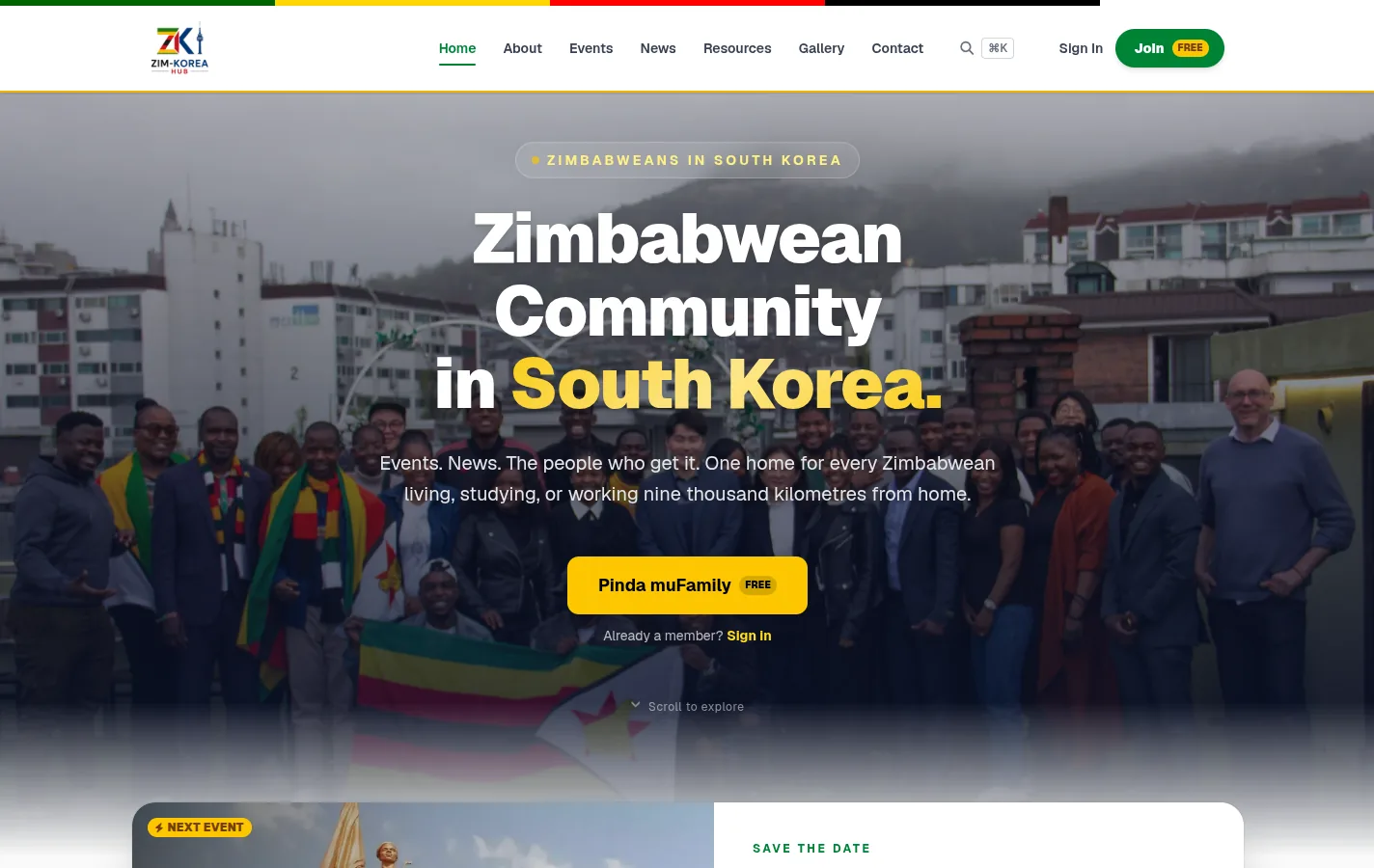
Not a pilot and not a demo. Zim-Korea Hub has been the Zimbabwean community's system of record in South Korea since April 2026 — members, events, guides and a complete photo archive.

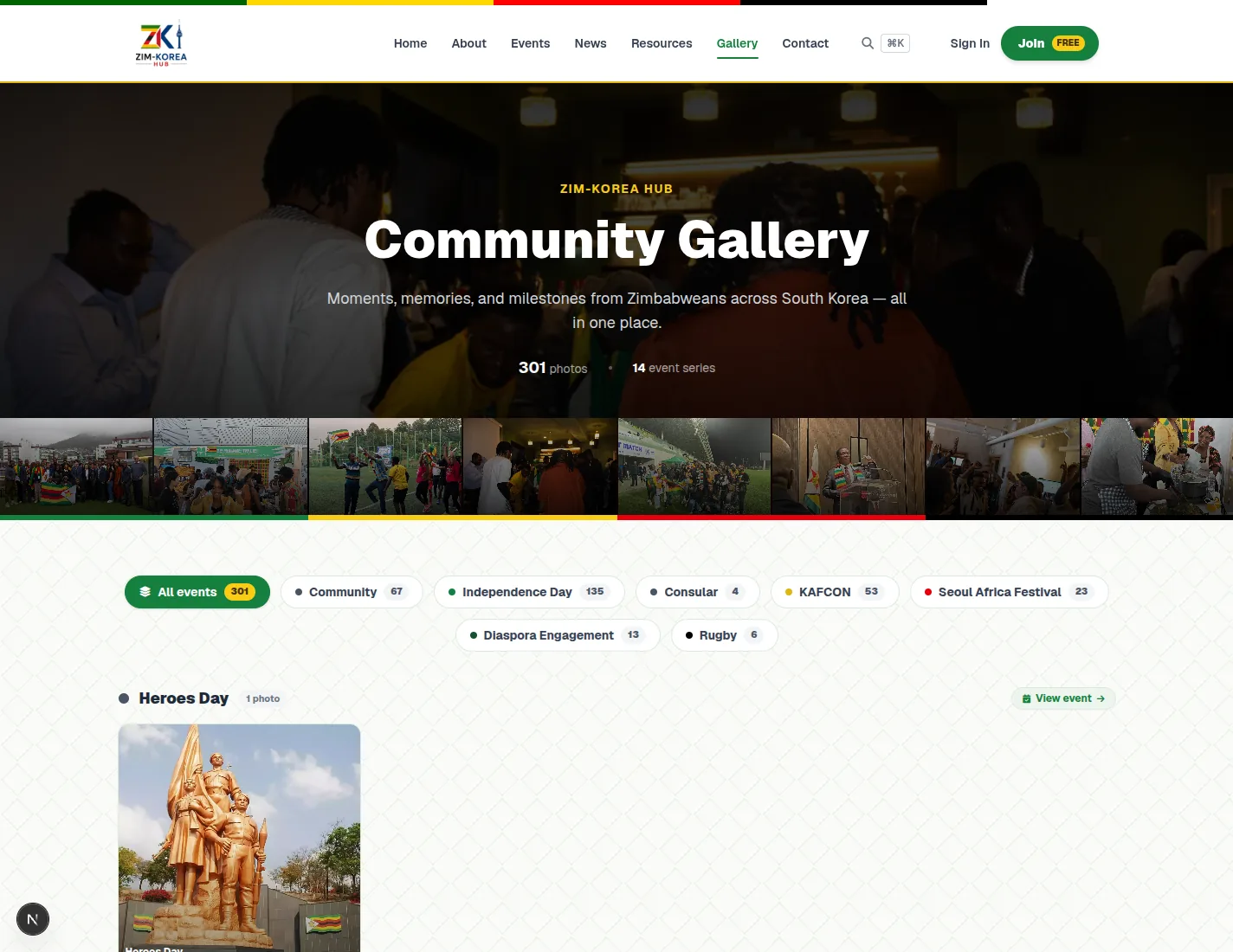
301photos archived
14event series
16events on record
7survival guides published
The Zim-Korea Hub home page, live at zimkorea.statotec.com
The community photo archive, live at zimkorea.statotec.com/gallery
zimkorea.statotec.com · live right now Their flag colours, their domain, their database

Independence Day rooftops, KAFCON football, the Seoul Africa Festival, a presidential diaspora engagement, a consular visit — four years of a community's life in one place, which the next committee will inherit intact.

Who's on it

Growing one community at a time.

We would rather name every community on the platform than quote a number. This is all of it.

🇿🇼🇰🇷

Zimbabweans in South Korea

Zim-Korea Hub · running since April 2026 · 301 photos, 16 events, 7 guides

Live
🇰🇪🇰🇷

Kenyans in South Korea

Quoted · roughly 800–1,000 members · Kenya guides written

In discussion
🇱🇷🇰🇷

Liberians in South Korea

Quoted · roughly 800–1,000 members · Liberia guides written

In discussion
How it works

Live in one to two weeks.

The platform already exists, so nothing is being built for you. What takes the time is your branding, your content and your member list. Nobody has to learn a page builder.

Day 1

You accept and pay the setup fee

You give us one named contact with authority to decide, not a committee thread. We create your site and your own separate database the same day.

Day 2 or 3

One setup session, about 90 minutes

Together, on a call: your colours from your flag, your logo, your first pages, and your committee's admin accounts. You finish the call with a working site.

That week

You fill it in

Your events, your news, your photographs, and your member roll imported from whatever state it is in. A messy spreadsheet is fine. The country guides for Korea and for home are already written and already there.

Week 2

Launch

It goes live at your Diaspry address, or at your own domain if you have bought one. Monthly billing starts that day, not before.

The timeline holds if you turn up to the setup session with your logo, your member list and ten to twenty photographs. Waiting on content is the usual reason projects like this slip, and it is the one part we cannot do for you.

Your data

It is yours, and we put that in writing.

Community organisations get burned by this, so it goes in the contract rather than in a blog post about our values.

Your own database

Not a row in a shared table with a customer ID on it. Your members live in a database that belongs to your association and is physically separate from every other community we host. Nothing is shared, sold, or used to advertise to your members.

Leave whenever you like

Thirty days' notice once the first year has run. We hand over a full export of your database, in a format anything can read, and you can pull one yourself any time before that. No exit fee and no hostage-taking: you should stay because the platform is worth it, not because leaving hurts.

Built to Korea's PIPA

You are holding immigration status and home addresses of foreign nationals. Encrypted connections, hashed passwords, access limited by role, and a written data-processing agreement signed alongside the contract.

If the community splits

The association named on the contract keeps the data. We will not adjudicate between factions, and we will not hand your member roll to anyone who is not your named contact.

Survival guides

The reason new arrivals join, and stay.

Practical guidance for the first year in a new country, researched properly and written for your community. Korea shown here as the worked example.

The host-country pack

Written once per host country and shared by every community in it — so for Korea it is already finished before you sign.

  • Getting your residence card (the ARC, in Korea)
  • Opening a local bank account as a foreigner
  • Phone contracts without a local credit history
  • Healthcare & national insurance

Your home-country pack

Researched with your committee, specific to your country, and rewritten when the rules change.

  • Sending money home
  • Shipping parcels home
  • Your embassy & consular help
  • Voting from abroad

We write what is true and say plainly when something is not possible, which is more use to a member than a guide that guesses.

Pricing

One price, set only by your size.

₩250,000 (US$181) to set you up, then a monthly fee that depends on nothing but how many members are on your roll. For a community of 900 that is about ₩280 (US$0.20) per member once, and ₩1,330 (US$0.96) per member a year. Priced in won today; billed in your currency where we can.

Under 200

Newer or smaller associations.

₩50,000/mo · ≈US$36
₩250,000 setup · ≈US$181
  • Public website, your colours
  • Member directory & roll
  • Events & RSVP
  • News
  • Photo archive
  • Email broadcasts
  • Raffles & draws
  • Committee roles
  • Survival guides, written for you
  • Your own separate database
Enquire

200 to 499

Established associations.

₩75,000/mo · ≈US$54
₩250,000 setup · ≈US$181
  • Public website, your colours
  • Member directory & roll
  • Events & RSVP
  • News
  • Photo archive
  • Email broadcasts
  • Raffles & draws
  • Committee roles
  • Survival guides, written for you
  • Your own separate database
Enquire
Most associations

500 and above

A few hundred to a few thousand members.

₩100,000/mo · ≈US$72
₩250,000 setup · ≈US$181
  • Public website, your colours
  • Member directory & roll
  • Events & RSVP
  • News
  • Photo archive
  • Email broadcasts
  • Raffles & draws
  • Committee roles
  • Survival guides, written for you
  • Your own separate database
Book a walkthrough →

Same product at every size. Nothing is held back at a smaller band, and there is no tier above this to upgrade to. Your band is checked once a year at renewal and never in between, so recruiting during the year does not change your bill. The count is every member on your roll, alumni included.

Terms. The setup fee is due on acceptance and monthly billing starts the day you go live. Minimum term is twelve months from launch, then thirty days' notice either way. The fee covers hosting, database, image storage, email delivery, backups, security updates, uptime monitoring and every platform improvement we ship. Support hours are not included at any band: bug fixes and email support are, and anything hands-on is ₩60,000/hour, always quoted before we spend it.

Your domain, whenever you want it. Your site starts on a Diaspry address. Buy a domain in your association's name at any time and we will point the site at it and move you across, at no charge. The domain is yours, registered by you, and you can take it anywhere. Online dues collection is not included yet; if your association holds a Korean business registration we can connect it under your own merchant account, so the money goes from your members to you and we never touch it.
Who builds it

Two software companies, not a weekend project.

Diaspry is built by Statotech Systems and Ebenworks. The people who sell it are the people who run it.

Statotech Systems

Statotech Systems

Systems engineering out of Seoul. Runs the Zim-Korea deployment and leads delivery on every community build.

Ebenworks

Ebenworks

An AI and software company founded in 2026, Seoul and Zimbabwe. Nine products in the fleet — Diaspry shares its platform, security posture and release discipline with all of them.

Isolated by default One database per community. There is no communityId column anywhere in the schema, so cross-tenant leakage is not a bug we can have.
Independent deploys Each community is its own project on its own release trigger. A bad build cannot take the fleet down.
Fleet migrations Schema changes roll across every community database from one runner, with status checks. Destructive in-place pushes are disabled on purpose.
Written commitments Data-processing agreement, export on demand, thirty-day exit, and a named owner if a community ever splits.
Thirty minutes, no commitment

You don't have to build any of it.

We will walk your committee through a community that is already running — the real site, real members, real data. Then you decide.